Visipix.com
I received a most interesting email from a salesman of one of the cellular carriers my company uses to provide Location Based Services to our customers. We had been experiencing some technical difficulties that resulted in several of our customers not being able to communicate to our LBS devices. All LBS devices operate using the cellular networks, usually GSM although CDMA has a strong presence in the US because it is used by Verizon and Sprint. Our carrier has always been helpful and technically capable, good traits when dealing with problems that result from complex cellular issues such as SIM activation, roaming or HLR/VLR problems. Only after forming a task force with one of our most important distributors, the device manufacturer, the carrier and technical expertise within our organization, were we able to isolate the problem as an easy-to-resolve hardware issue and nothing to do with the carrier.
What caught my attention about the salesman's email was that he had attached a research paper from the Journal of Information Science and Engineering titled The Evaluation of Distributed and Replicated HLR for Location Management in PCS Network by Guan-Chi Chen and Suh-Yin Lee. I am certain that I was the only cc on that email who gave any consideration to this document. Although this salesman is technically savvy and always willing to get involved in the technical aspects of his job, sending that document was a clear indication that he had literally thrown in the towel. He was now reaching for any possible explanation, the more technically convoluted the better.
It reminded me of years past when I used to sell Alpha Micro mini-computers as part of "turn-key solutions" bundled with software I developed for the Field Service Management industry. I remember a specific incident when I made the same mistake that all technical salespersons make sooner or later: Over-reaching for far-fetched technical explanations that just do not make any sense, leaving the customer disconcerted and jeopardizing the trust the customer has placed on you: I had sold a new system with about fifty terminals that were attached to the computer system via RS-232 connections. My customer had a large building and we had pushed the limits of the RS-232 specification causing their brand new, and very expensive system, to crash almost on an hourly basis. I contracted wiring and electrical specialists to check for any electrical interferences which have always been a source of problems for RS-232 connections. I rewired my customers systems with special insulated cabling. I convinced them to upgrade their electrical systems; Nothing worked! Their new system still kept crashing with hourly regularity. In frustration, I explained to my customer that their system's problems could be caused by "cosmic rays" I had not pulled that explanation out of a hat. This was something that Alpha Micro had actually suggested as a possible problem. But the minute, I presented this possibility to the customer, it was obvious that I had run out of ideas and possible solutions, risking the hard-earned relationship of trust I had with my customer Luckily, Alpha Micro engineers got involved because this happened to be one of the first machines of their new product line. A little tweaking with the I/O interface provided the ability of using more robust RS-422 connections and that along with serial repeaters finally resolved the problem.
Owning a small software development company for many years taught me to wear many hats. Wearing the hat of a technical salesman was easy because I developed the software I sold, I picked the hardware and O/S that it ran on and I even picked the accounting system that my software integrated with. When you believe in what you sell and you understand the technical aspects of the product you are selling, you easily gain a level of trust from prospects. If one can hit the prospect's "hot buttons" and provide solutions to the prospect's problems, those prospects soon become trusting, long-term customers.
As an Alpha Micro Value Added Reseller, I had to take part in several sales training courses. Some of the most interesting courses had to do with selling leasing services. In my opinion, most sales courses make use of gimmicky techniques that eventually backfire. And most salespeople think that their success can be attributed to a special personal trait or a specific technique they have developed to "close the deal." This may be true for some types of sales but the most interesting and straight-forward facts I learned about salesmanship came from a small gem of a book titled The Lacy Techniques of Salesmanship by Paul J. Micali. Among the many salesmanship nuggets this little book contains, there are the following:
THREE THINGS [THAT] DETERMINE YOUR VALUE AS A SALESPERSON
- Technical knowledge.
- How much work you are willing to do (this along with technical knowledge controls the quality of your salesmanship).
- Personality (this element controls quality).
When technical problems arise, Micali's three things also apply, except in the reverse order: (1) A salesperson must have a strong personality to resist offering esoteric explanations to technical problems. (2) He must work hard to trouble-shoot the problems or to assemble and assist a technical team that can troubleshoot the technical problems and (3) He must have enough technical knowledge to be able to understand the possible causes of the problems and how to go about resolving them.


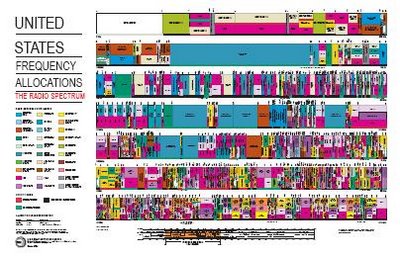
available from
National Telecommunications and Information Administration
My company has Value Added Reseller relationships with several cellular carriers. That is because most digital devices used for Locations Base Services work over the cellular network just as regular cell phones do and thus they need a SIM that is provided and activated by a carrier. A delay in a VAR application to a big carrier caught my attention; The application had been properly filled and submitted weeks ago. However, we received a notice to get in contact with a special Department. The information requested was basic and already included in the application which me made question why this carrier was presenting this additional hurdle.
The answer was provided by the many articles popping in the business and IT publications; 1,122 licenses for a couple of slivers of the US radio spectrum are being auctioned off by the Federal Communications Commission. I suspect that our carrier is involved in these auctions and probably has to disclose or update information about its VAR's.
FCC Auction 66 is also known as Advanced Wireless Services (AWS-1) which "...is the collective term used for new and innovative fixed and mobile terrestrial wireless applications using bandwidth that is sufficient for the provision of a variety of applications including those using voice and data (such as internet browsing, message services, and full-motion video) content..." That has to sound exciting for not just for the gearheads and the geeks but for anyone that has a cell phone.
FCC auctions have always intrigued me. All kinds of new technologies are enabled by the availability of new frequencies, often resulting in revolutionary product and services. Remember when pagers were an essential business gadget? Cell phones evolved from a brick-size device we were willing to lug around just for the sake of instant communication. Today, nobody considers a cell phone unless it fits into a shirt pocket and has a combination of sophisticated built-in gadgets such as a music player, a camera, a video-cam, even a thumb-size keyboard so that we can respond to emails and surf the the net anytime, anywhere.
I think that AWS will result mainly in evolutionary rather than revolutionary products and services. Wireless broadband has been available from the major cellular carriers for a while. They are well on their way, implementing 3G technologies across the US. (And playing catch-up to Asia and Europe where the ubiquitousness of GSM makes the roll-out of new cell phone technologies easier) All the promises of 4G will be undoubtedly be enabled by the availability of the newly auctioned FCC frequencies. Over the last few months, we have seen the introduction of Verizon's VCAST Service that allows the download of music and videos to Verizon phones from LG, Samsung and Motorola. Sprint has similar services but what I find most interesting is that one can now listen to SIRIUS Satellite Radio on a multimedia Sprint phone. This marriage of satellite and wireless is not going to be limited to cellular carriers offering satellite-only services over their networks as the bidding for Auction 66 clearly illustrates. The most aggressive bidders so far has been a group that includes DirectTV and and Echo Star Communications. The analysts believe that the satellite-TV operators do not want to be left out of the multiple service offerings that cellular carriers and cable companies are providing now and will keep on improving with AWS.
So will AWS just mean video bilogging on every cell phone? That's already happening and the blogosphere is using it in some creative ways that will keep on challenging traditional media. What could be really wonderful is if Google and Yahoo finally deliver on their half-hearted efforts (Google WiFi and at&t Yahoo) and actually start delivering their contents on their own backbone in a new innovative way; A good chunk of those AWS spectrum slivers would make that possible!
The other intriguing factor of FCC auctions is all the rags-to-riches stories that are now part of the history of the telecommunications industry. Even today, there seems to be some opportunities in FCC Auction 66, according to Information Week:
"...The FCC has divvied the spectrum into hundreds of rural licenses--rather than a handful of licenses that span large geographic areas--making it easier for smaller providers in remote cities and towns to bid. They also get a financial advantage in the process; smaller providers that bid on spectrum are required to pay just 75% to 85% of their winning bidding price, according to FCC rules, while large providers pay 100% of their winning bids..."
I wonder if anyone has yet bid for the Northern Marianas?

Visipix.com
Speaking of Google for searching addresses and phone numbers, if you include a City and State in your query you will get Google Local results with not just the address and phone information but also an embedded map which is, of course, a Google Map and that I have just discovered has now become Google Local; Google Maps is no longer in Beta! If you are interested in other Google Hacks, O'Reilly is a great place to start.
I recently heard about 1-800-555-TELL (1-800-555-8355) which is a phone service that provides all types of information via recorded messages and text-to-speech. I played with the service for about an hour and got mixed results. To start with, the speech recognition is somewhat frustrating, it doesn't always work plus the way the menu prompts are presented do not seem to allow for quick interruption and successful recognition of subsequent commands. The speech recognition seems to improve if you do not use a speaker phone. The service quickly becomes annoying because of the smarminess of the menu messages.The information available through the service is presented as follows:
- Stock Quotes.
- News Center: Weather, Traffic, Business, Technology, Entertainment News, Sports Update, Lottery & Time.
- Sports: All major professional and college sports including a couple of unexpected choices like Boxing and Soccer.
- Entertainment: Movies, Horoscopes, Soap Operas & Blackjack.
- Travel: Driving Directions & Taxi.
- Popular Shortcuts: A short list of the above.
Unless you are a teenager, using SMS to communicate is an exercise in futility. You can pretend to be up to speed and learn the lingo but wouldn't it be better if you could send a well formed text message that you could type? Like an email but not an email because although most business people can access their emails from their phones not everyone has this capability. It turns out that you can send a text message to a special email address and it will be received as SMS by any cell phone. The special email address depends on the recipient's carrier but it always starts with the full cell phone number as in "1" + Area Code + Phone Number (i.e. 19495551212 for (949) 555-1212). Following are most of the SMS email addresses for the US:
- AT&T:FullCellPhoneNumber@mmode.com
- Cingular:FullCellPhoneNumber@cingularme.com
- Nextel:FullCellPhoneNumber@messaging.nextel.com
- SprintPCS:FullCellPhoneNumber@messaging.sprintpcs.com
- T-Mobile:FullCellPhoneNumber@tmomail.net
- Verizon:FullCellPhoneNumber@vtext.com
- Virgin-Mobile:FullCellPhoneNumber@vmobl.com
 icon on your Firefox toolbar. And you are not restricted to 160 characters but
can send up to 800 characters that are received as 5 separate text messages. All
email to SMS services will result in standard SMS charges to the recipient.
icon on your Firefox toolbar. And you are not restricted to 160 characters but
can send up to 800 characters that are received as 5 separate text messages. All
email to SMS services will result in standard SMS charges to the recipient.
Paul English came up with the IVR Cheat Sheet™ which has been widely publicized by blogs and the news media because of the originality and usefulness of his idea. He created a list of major US companies, their 800 number and more importantly he documented the "steps to find a human" so that you won't have to suffer IVR (interactive voice response) hell or be subsequently aggravated by the long wait for a Customer Service representative. The conventional wisdom is that companies automate their systems to discourage an actual connection to a human operator. It will be interesting to see if companies adjust their system to adapt to Paul's hack. He seems to understand how telephony systems are put together and will probably figure out any changes to IVR configurations. He is also counting on getting feedback from the public at large to keep his useful database up to date. Paul also a page with other great phone tips.
Mobiledia provides a great Cell Phone Reception and Tower Search utility which is even integrated with Google Maps. It is an excellent way to determine the best carrier for your locale or to check for tower proximity which might prove invaluable when looking for good reception in a new area. Mobiledia allows this utility to be incorporated into any webpage, free of charge. All carriers have their coverage maps but if you have a GSM phone, GSM World has the most complete GSM Coverage Maps and Roaming Information to my knowledge.
Google Mobile provides an interesting array of tools if one has web access through the cell phone. It includes Gmail, a personalized Google homepage and Google Local for mobile which unfortunately does not currently work with Nextel or BREW enabled phones (Verizon, Alltel, US Cellular) or Palm devices. Most carriers include their own personalized mobile homepage and there are quite a number of interesting alternatives such as Yahoo Mobile. What is unique about Google Mobile services is that it provides Google SMS which is like the 1-800-555-TELL service except it is all via SMS. You submit queries to Google from your cell phone via SMS and Google responds back with useful information. I will probably not use this service much because I think I need to have a cheat sheet to properly form the queries. And if I have to access a cheat sheet, I would probably need access to my laptop, in which case I would use the real thing! I don't use the web browser on my cell phone and I often wonder if a Blackberry or a Treo would better serve my telecomunication needs. Sounds like a topic for a future blog entry!

Visipix.com